
How to Write a Mobile RFP That Actually Gets You the Right Agency
A practical guide for writing an RFP that attracts strong partners, surfaces real differences, and sets your app up for success.


You've secured a budget for a mobile app. Leadership is aligned. Now you need to find the right development partner — and that means writing a Request for Proposal.
Here's the problem: most mobile RFPs fail before a single agency reads them. They're either so vague that every response looks the same, or so prescriptive that they scare off the partners best equipped to challenge your assumptions. After years of reviewing and responding to RFPs at Very Good Ventures, we've seen both extremes — and everything in between.
This guide will help you write an RFP that attracts serious partners, surfaces meaningful differences between proposals, and sets your project up for success from day one.
Start With the Problem, Not the Solution
The strongest RFPs lead with business context. Before you describe screens, features, or integrations, tell prospective partners why this app exists. What business problem does it solve? What does success look like in six months? In two years?
A good problem statement might read: "Our field technicians currently use paper forms that take 48 hours to process. We need to cut that to real-time." That single sentence tells an agency more than a 40-page feature list. It reveals the user, the pain point, the urgency, and the success metric — all in one breath.
Agencies worth hiring will design better solutions when they understand the underlying problem. Agencies that just want a spec to execute against will build exactly what you asked for, whether it's the right thing or not.
Define Your Users Before Your Features
Every mobile app serves someone. The RFP should describe those people clearly: who they are, what devices they carry, where and how they'll use the app, and what technical literacy you can expect from them.
Field workers on rugged Android tablets in spotty cell coverage demand a fundamentally different architecture than corporate executives reviewing dashboards on the latest iPhone. Offline-first data sync, camera and sensor integration, accessibility requirements, internationalization — these constraints shape every technical decision downstream. Surface them early so agencies can respond with realistic approaches instead of optimistic guesses.
Include What You Know (and Admit What You Don't)
The best RFPs are honest inventories of certainty and uncertainty. Be specific where you can:
Existing systems and integrations. Name your ERP, your CRM, your authentication provider. Call out REST vs. GraphQL, API versioning, known rate limits. If an agency needs to interface with a legacy SOAP service from 2008, say so now — that detail will materially affect estimates.
Compliance and security requirements. HIPAA, SOC 2, GDPR, FedRAMP — these aren't afterthoughts. They shape architecture, hosting, CI/CD, and testing strategy. An agency that discovers compliance requirements mid-project will burn weeks and budget adapting.
Design maturity. Do you have a design system, Figma files, or brand guidelines? Or does the agency need to start from research and wireframes? The gap between "we have production-ready designs" and "we have a napkin sketch" is easily a six-figure difference in scope.
Timeline and budget range. Agencies cannot give you a meaningful proposal without understanding your constraints. You don't need to state an exact number, but a range — or at minimum, an order of magnitude — prevents everyone from wasting time. If your budget is $200K and the project requires $1.5M, both sides benefit from knowing that upfront.
Where you lack clarity, say so directly. "We haven't decided on a backend provider" or "We're open to recommendations on analytics tooling" gives agencies room to demonstrate expertise. Uncertainty isn't a weakness in an RFP — hidden uncertainty is.
Address the Platform Question Head-On
One of the most consequential decisions in any mobile RFP is platform strategy: native, cross-platform, or web-based. Your RFP should state your current thinking and invite agencies to challenge it.
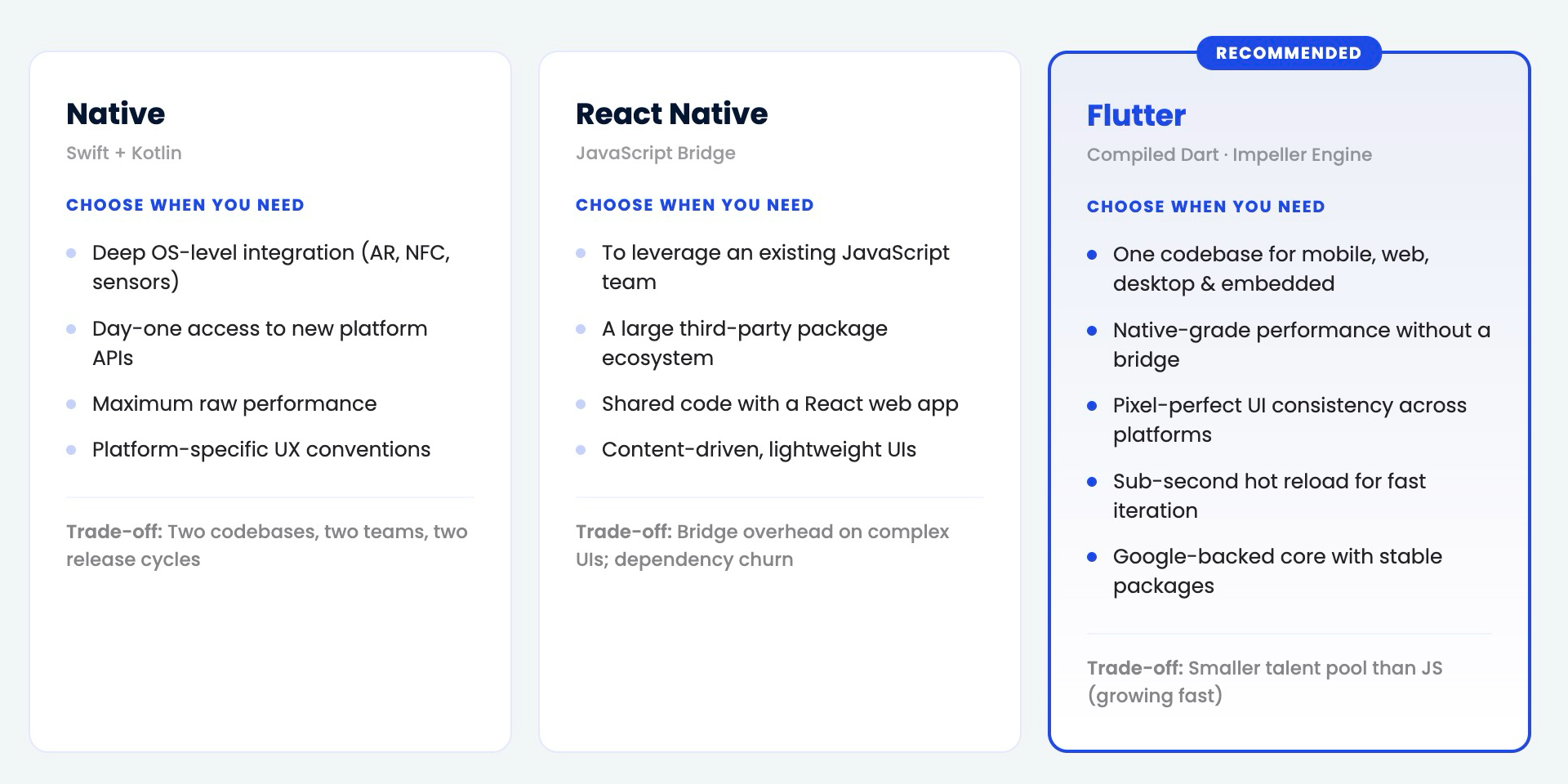
Native development (Swift/Kotlin) delivers maximum platform fidelity and access to the latest OS features on day one. The trade-off is maintaining two separate codebases, two teams, and two release cycles. For apps that push hardware boundaries — AR, complex animations, deep OS integration — native still makes sense. For most business applications, though, the overhead is hard to justify.
React Native popularized the cross-platform approach with JavaScript and a bridge to native components. It has a large community and an enormous ecosystem of third-party packages. However, that bridge architecture introduces performance bottlenecks for complex UIs, and debugging often requires digging through native layers anyway. The reliance on third-party packages for core functionality can also create long-term maintenance risk.
Flutter takes a different approach entirely. Instead of bridging to platform UI components, Flutter renders every pixel directly through its own high-performance engine (Impeller on iOS, Skia and Impeller on Android). This gives development teams pixel-perfect control across platforms without platform-specific rendering inconsistencies. A single Dart codebase compiles to native ARM code — not interpreted, not bridged — which means performance characteristics closer to native than any bridge-based framework can achieve.
Flutter's advantages compound over the lifecycle of a project. A single codebase means one team, one set of tests, one CI/CD pipeline, and simultaneous releases on iOS and Android. Google maintains the framework and its core packages, so teams spend less time chasing community-maintained dependencies. The widget-based architecture makes UI composition predictable and testable. Hot reload keeps development velocity high. And Flutter's reach now extends beyond mobile to web, desktop (macOS, Windows, Linux), and embedded devices — meaning the investment in a Flutter codebase can scale to new surfaces without starting over.
At VGV, we've built Flutter applications across industries — from consumer apps with millions of users to enterprise tools running on embedded hardware. The framework's maturity, Google's continued investment, and the growing ecosystem make it the strongest cross-platform choice for most mobile projects today.
Your RFP doesn't need to mandate a technology. But if you state your platform preferences and invite agencies to propose alternatives with rationale, you'll learn a great deal about how each partner thinks.
Structure Your RFP for Comparison
When three or five agencies respond to your RFP, you need to compare them meaningfully. Structure helps. Ask every respondent to address the same core areas:
Technical approach. How will they architect the application? What frameworks, state management patterns, and backend services do they recommend, and why?
Team composition. Who will work on your project? What are their roles and relevant experience? Will the team be dedicated or shared across clients?
Process and communication. How do they run sprints? How will you see progress? What does their QA process look like? How do they handle scope changes?
Timeline and milestones. Break the project into phases with deliverables. Avoid agencies that give you a single end date and nothing in between.
Pricing model. Fixed bid, time-and-materials, or hybrid? Each has trade-offs, and the right model depends on how well-defined your scope is. Ask agencies to explain their recommendation.
Risk identification. The best partners will tell you what might go wrong. An agency that identifies no risks in a complex mobile project is either inexperienced or not being candid.
Set a Realistic Evaluation Timeline
Give agencies enough time to respond thoughtfully — two to three weeks minimum for a meaningful proposal. Rush timelines produce shallow responses and favor agencies with excess capacity rather than the best fit.
On your side, commit to a decision timeline and communicate it. Nothing damages a client-agency relationship faster than a four-month evaluation silence followed by "can you start Monday?"
A Few Things That Separate Good RFPs From Great Ones
Name a single point of contact. Agencies need someone to ask questions. Ambiguity about who owns the relationship creates friction before the project even begins.
Share evaluation criteria. If you weigh technical expertise at 40%, cost at 30%, and cultural fit at 30%, say so. Agencies will tailor their responses to what you actually care about.
Allow (and encourage) questions. A Q&A period between RFP release and response deadline improves every proposal. Publish answers to all participants so the playing field stays level.
Be open about incumbents. If you have an existing vendor and this RFP is a genuine evaluation, say so. If the incumbent has an inside track, ethical agencies will appreciate the honesty — and may still compete if the opportunity is real.
The RFP Is the Relationship's First Test
How you write your RFP signals how you'll run the project. Clear communication, honest constraints, and structured expectations attract partners who operate the same way. Vague requirements, hidden agendas, and unrealistic timelines attract partners willing to tell you what you want to hear.
Write the RFP you'd want to receive, and the right agency will find you.
Very Good Ventures is a leading Flutter development consultancy. We partner with organizations to build multi-platform applications with a single codebase, from mobile to web to embedded. If you're preparing an RFP and want to talk through your approach, reach out — we're happy to help even before the formal process begins.