 Image generated with Google Gemini, prompt by the author, February 2026
Great engineers ask clarifying questions. They know that unclarified assumptions lead to technical debt.
So why do we let our AI coding assistants guess?
What is the AskUserQuestion Tool?
AskUserQuestion Tool is a built-in capability in Claude Code that lets AI pause and ask you structured questions before producing any code. Instead of making assumptions about your intent, Claude presents you with options, gathers your input, and proceeds with clearer steps guided by you.
In practice, it looks like this: you ask Claude to add authentication to your Flutter app. Rather than immediately scaffolding a username and password flow (or worse, picking a random auth package that’s not been vetted), Claude stops and asks:
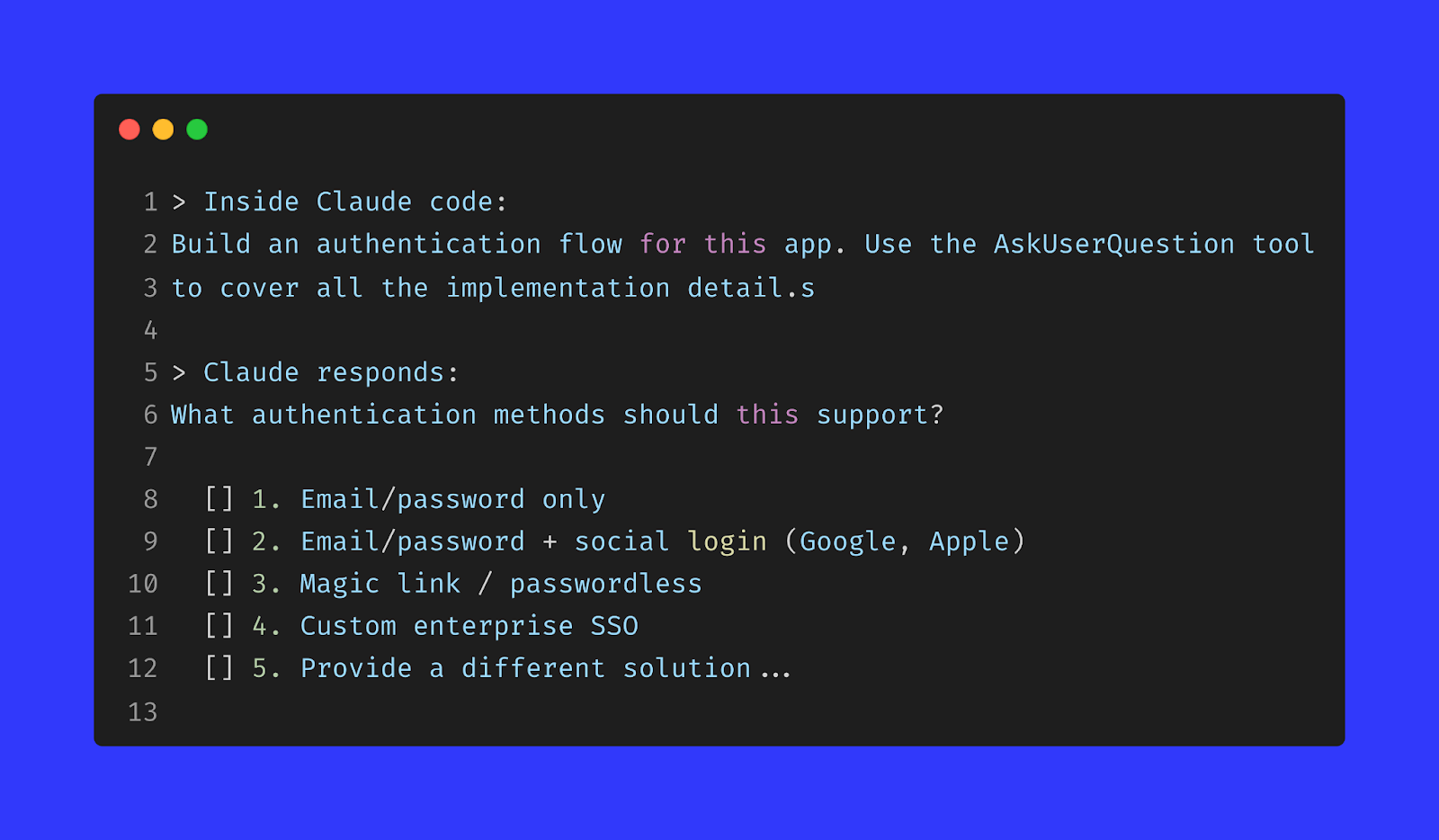
You pick an option. Claude asks another question. And another. By the time it writes code, every major decision has been explicitly made by you.
Even better, make it a skill
Skills are a great way to extend Claude’s capabilities, as if you were teaching Claude additional tips and tricks to perform on your behalf.
This particular skill will create a highly detailed spec file that will help Claude be more successful on a single shot implementation of your feature.
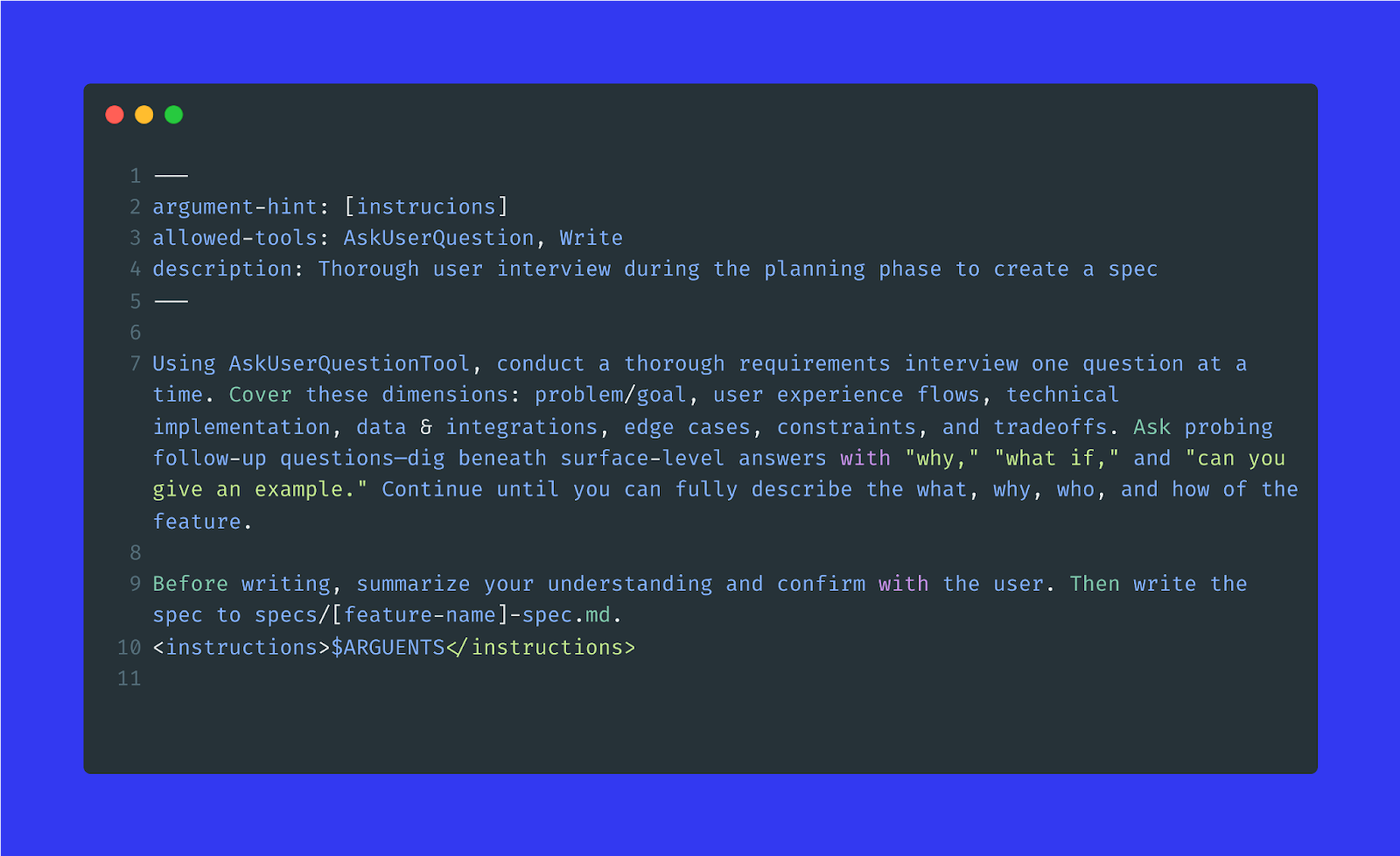
When You Should Use it
These are some of the ways I’ve been using AskUserQuestion, but you’ll certainly find more use cases where the tool will be highly useful.
Complex features with branching implementation paths
If there’s more than one reasonable way to build something, the AskUserQuestion tool helps you navigate those forks before they become buried in code.
For example, adding a caching layer to your Flutter app? Claude can ask whether you need offline-first behavior, what your cache invalidation strategy should be, and whether you’re targeting mobile-only or web as well.
Ambiguous requirements
“Add analytics” means something different on every project. Using AskUserQuestion forces you to specify:
- What events matter?
- What’s your privacy stance?
- Do you need real-time dashboards or batch reporting?
These aren’t the kinds of questions Claude should guess the answer to.
Spec-based development workflows
Some teams have adopted a two-session pattern. First, let Claude interview you to build a detailed spec; then, start a fresh session with that spec as context and let Claude execute. The interview phase surfaces edge cases and tradeoffs you might not have considered, while the execution phase benefits from having all ambiguity pre-resolved.
For Flutter development projects specifically, this is powerful. Your architecture, state management approach, and package choices are deeply interrelated. Getting Claude to ask about your Bloc vs Riverpod vs Provider preference before it generates code means less refactoring later.
Onboarding to a new codebase
If Claude doesn’t know your conventions, it should ask. Combining AskUserQuestion with Plan Mode lets Claude explore your codebase, identify patterns, and confirm assumptions before proposing changes.
When it Gets Annoying to Use
As always, using the right tool for the right job is half the battle. In my experience, AskUserQuestion works wonders for large areas of work that I might need extra confidence that I flash out properly.
However, there were a handful of times when it didn’t work for me.
The task is simple and unambiguous
If you’re asking Claude to “add a null check to this function”, you don’t need an interview. The tool is valuable for decisions that have meaningful tradeoffs, not for tasks with obvious answers.
When you want exploratory conversation
The AskUserQuestion tool presents structured multiple choice options. If you’re in discovery mode and want to think out loud with Claude (e.g. exploring half-formed ideas, or getting feedback on whether something is even feasible), a free-form conversation is better. The formality of the tool can feel constraining when you’re still figuring out where you want to go.
Trivial implementation details
Not every question deserves human escalation. If Claude is asking “Should this variable be named userId or user_id?”, something has gone wrong. The tool works best for architectural and product-level decisions, not syntactic choices your linter should handle.
The Real Value: Explicit Tradeoffs
Here’s what changes when Claude starts asking questions:
Decisions become visible
Every answer you give is a design decision captured in the conversation history. When you revisit the code in six months wondering why you went with localstorage instead of flutter_secure_storage, the reasoning is documented.
Assumptions become testable
Instead of discovering buried assumptions during a code review (“wait, why does this retry three times with exponential backoff?”), you confront design decisions upfront when they’re cheap to change.
Your spec gets stress-tested
This might be, by far, the most important element. Claude is relentless about edge cases. “What should happen if the network request succeeds, but returns malformed JSON?” “Should this animation run on first launch only, or every time?” These are questions you should have answers to, and the interview forces you to answer them.
Introducing AskUserQuestion in Your Flutter Development Flow
The most effective pattern we’ve seen combines AksUserQuestion with Claude Code’s Plan Mode:
1. Start with a (minimal) spec
Write down what you’re building in a plan.md file, even just a few sentences describing the feature.
2. Ask Claude to interview you
A prompt like this works well:
Read @plan.md *and interview me in detail using the AskUserQuestion tool about technical implementations, UI/UX, concerns, and tradeoffs. Ask non-obvious questions. Continue until we’ve covered everything, then update the spec. *
3. Review and iterate
Claude’s questions will surface things you hadn’t considered. Update your answers. Ask follow-up questions of your own.
4. Execute with fresh context
Once your spec is solid, start a new session with that spec as a context. Claude now has clear direction and can execute with precision.
For Flutter-specific features, good use cases are:
- Target platforms and their unique behaviors
- State management approach consistency with your existing patterns
- Widget composition and reusability expectations
- Testing strategy (unit, widget, integration)
- Accessibility requirements
- Animation and performance constraints
The Bigger Picture
AI coding assistants are becoming capable enough that the bottleneck is shifting. The limiting factor isn’t “can the AI write this code?” It’s “does the AI understand what I actually want?”
AskUserQuestion tool inverts the typical prompt engineering relationship. Instead of you crafting the perfect prompt to get Claude to do what you want, Claude prompts you to clarify what you want. That’s a healthier collaboration pattern—one where the human stays in the decision-making seat while the AI handles the heavy lifting.
For Flutter engineering teams that care about craftsmanship, this matters. Quality isn’t just about the code that gets written; it’s about the decisions that inform that code. Making those decisions explicit, early, and visible is how you maintain high standards as AI becomes a bigger part of how you build.


