As artificial intelligence continues to reshape digital products, two closely but often confused terms have emerged: Generative AI (GenAI) and Generative UI (GenUI). While they’re frequently used interchangeably, they represent distinct layers of the modern AI product stack—and understanding the difference is critical for designers, developers, and business leaders building Generative experiences.
Here we break down:
- What GenAI is
- What GenUI is
- How they differ (and work together)
- When to invest in each
- Why the distinction matters for modern product development
What is Generative AI (GenAI)?
Generative AI (GenAI) refers to a type of artificial intelligence that can create new content—rather than simply analyzing or classifying existing data.
Core Capabilities of GenAI
GenAI systems can generate:
- Text (e.g. large language models like GPT)
- Images (e.g. diffusion models)
- Code
- Audio and video
- Structured data (e.g. tables, schemas, summaries)
Generative AI models (like Large Language Models or Diffusion Models) do this mathematically. They identify underlying patterns and structures in massive datasets and use probability to predict and construct new outputs.
Common Examples of GenAI
- Chatbots and AI assistants
- Code generation tools
- Image and video generators
- Content summarization and translation systems
- AI-powered data analysis tools
In short: GenAI is a creative engine that produces intelligence and content.
What Is Generative UI (GenUI)?
Generative UI (GenUI) is the experience layer where Artificial Intelligence builds the User Interface in real time based on the user context.
Rather than relying on fixed screens and predefined flows, GenUI systems generate interface elements on demand based on:
- User intent
- Context
- AI output
- Real-time data
Key Characteristics of GenUI
- Interfaces adapt instead of remaining static
- Layouts, components, or flows may be AI-generated
- Interaction models are often conversational, multimodal, or intent-based
- The UI evolves as the user’s needs change
Examples of GenUI in Practice
- A chat interface that generates custom forms on the fly
- An AI assistant that creates dashboards based on a question
- A design tool that builds UI layouts from text prompts
- An app that changes interaction patterns based on user behavior
In short: GenUI is the experience layer that presents AI-generated intelligence to users.
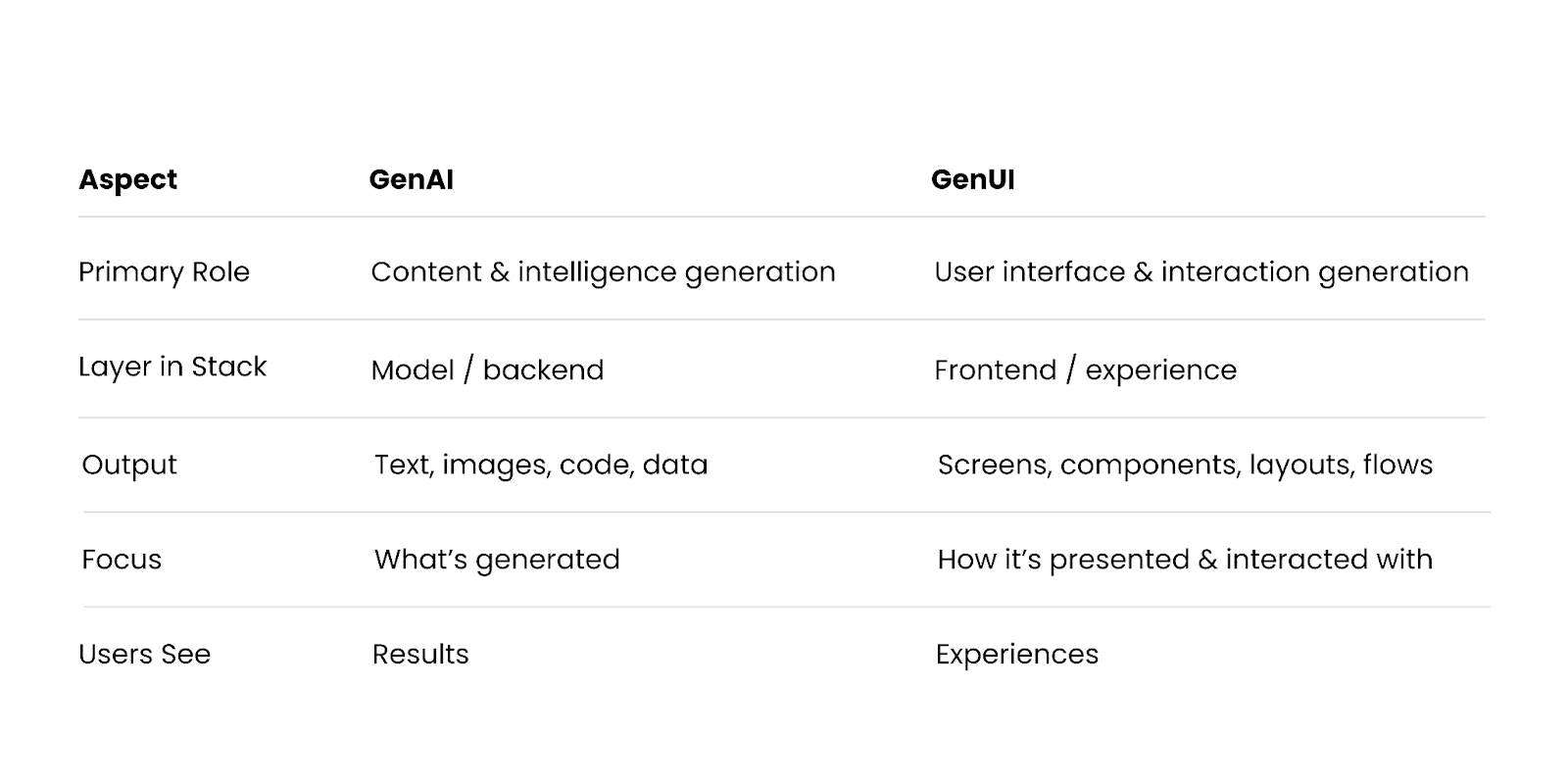
A helpful mental model:
- GenAI decides what to say or create
- GenUI decides how users interact with it
How GenAI and GenUI Work Together
GenAI and GenUI are most powerful when combined.
Example: AI-Powered Travel Planner
-
GenAI generates a personalized itinerary
-
GenUI dynamically builds:
- A timeline view
- Interactive maps
- Editable booking cards
- Context-aware recommendations
Without GenUI, users might only see a long text response. Without GenAI, the interface would be static and manual. Together, they create an adaptive, intelligent product experience.
Why the Distinction Matters
Understanding the difference between GenAI and GenUI helps teams avoid common pitfalls:
1. Better Product Strategy
Many teams invest heavily in models but underestimate the importance of interaction design. A powerful GenAI system can fail if the UI doesn’t help users:
- Understand outputs
- Build trust
- Take action
2. Clearer Team Ownership
- GenAI often lives with AI and backend teams
- GenUI requires strong collaboration between product, design, frontend, and AI engineering teams
Treating them as separate but connected disciplines leads to better outcomes.
3. Improved User Experience
Static UIs struggle to keep up with dynamic AI outputs. GenUI allows:
- Progressive disclosure
- Explainability
- Human-in-the-loop controls
- Personalization at scale
When Do You Need GenUI (Not Just GenAI)?
You should consider GenUI if:
- User intent is ambiguous or evolving
- Outputs vary significantly in structure or length
- Users need to refine, edit, or act on AI results
- Trust, transparency, or control is critical
- You’re building AI-native products (not AI features bolted onto legacy UIs)
In contrast, simple GenAI integrations (e.g., background summarization) may not require fully generative interfaces.
GenUI as the Future of AI-Native Products
As AI systems move from novelty to necessity, static interfaces will become a bottleneck. GenUI represents a shift from:
- Screens → Conversations
- Flows → Intent
- Interfaces → Experiences
In the same way mobile-first design reshaped products in the 2010s, AI-native design—powered by GenUI—will define the next era of software.
Final Thoughts
- GenAI is about generating intelligence and content
- GenUI is about generating experiences and interactions
- You need both to build truly effective AI-powered products
Teams that understand—and intentionally design for—the difference between GenAI and GenUI will be better positioned to create products that are not only powerful, but usable, trustworthy, and delightful.
Very Good Ventures makes it easy for our clients to achieve the right balance and use for their GenAI and GenUI. To see how we can help your brand, contact our experts.


